

Skip links

Natural Language Query

Access Structured Data with a Brand New Approach

NLQ redefines the way people interact with complex datasets by streamlining query formulation and data extraction. This method enables business users and data analysts to work more effectively, delivering faster, high-quality results, enhancing productivity and efficiency.

When integrated with advanced semantic technologies, NLQ improves output quality and supports data quality management.

Essence

Functioning

Applications

Benefits

AIWave
Approach

Essence

Functioning

Applications

Benefits

AIWave Approach

The essence of NLQ

NLQ systems leverage two distinct design paradigms, each suited to specific operational scenarios. The choice between these paradigms depends on variables such as the complexity of the underlying data schema and whether the data can be effectively preprocessed.

Natural
Language Query

NLQ, also referred to as natural language search, allows users to extract data using intuitive and business-friendly language. With this technology, query expressed in human language are automatically transformed into machine-friendly query syntax.

Whether it is through typed queries in a search box or through voice commands, NLQ systems intelligently interpret the user’s input and provide meaningful outputs.

Trusted Natural
Language Query

Trusted NLQ is a further development of Natural Language Query. This method leverages ontology-based technology to insert a semantic representation layer that effectively decouple the natural language inquiry layer from the underlying physical data querying mechanisms.

This separation enables effortless interaction with data, eliminating the need to understand or directly access complex raw data structures.

How it works

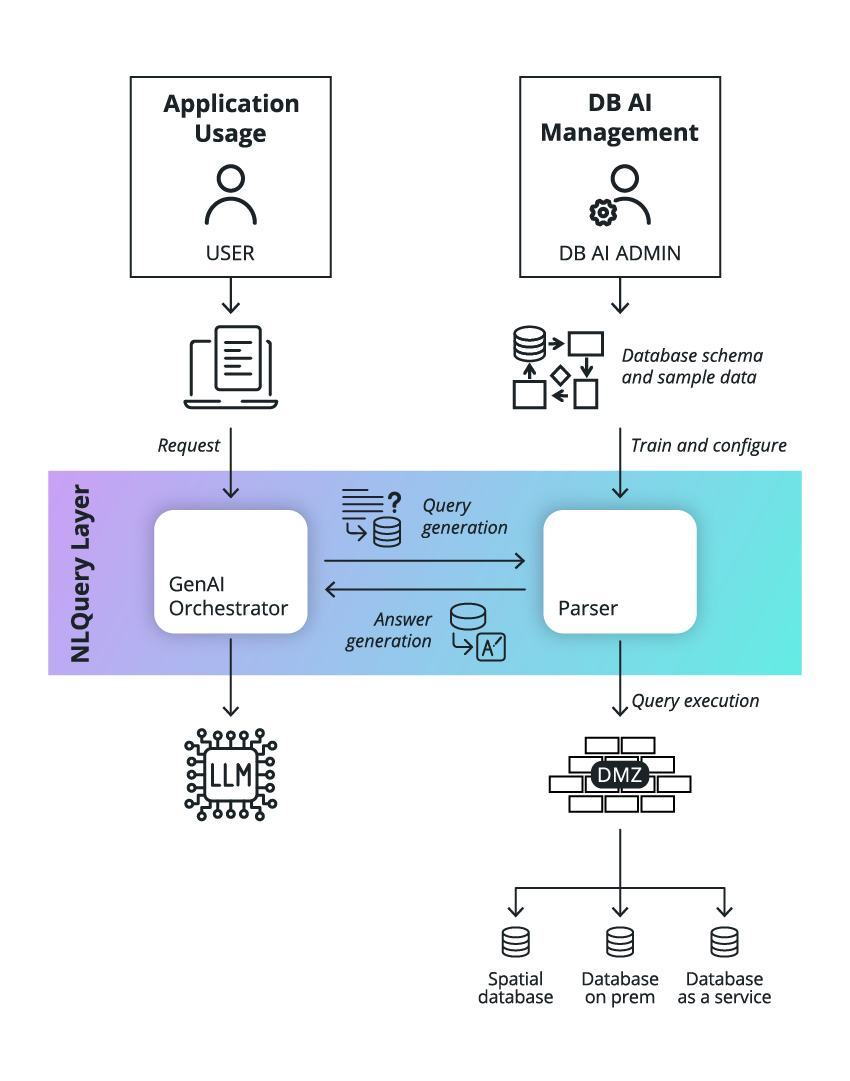
Natural Language Query Architecture

An orchestration layer directs user queries through the LLM, database, and NLU module. Input is parsed into query syntax and executed on the admin-managed database. The database response is then refined by the LLM, merging structured data with conversational clarity for a natural language output.
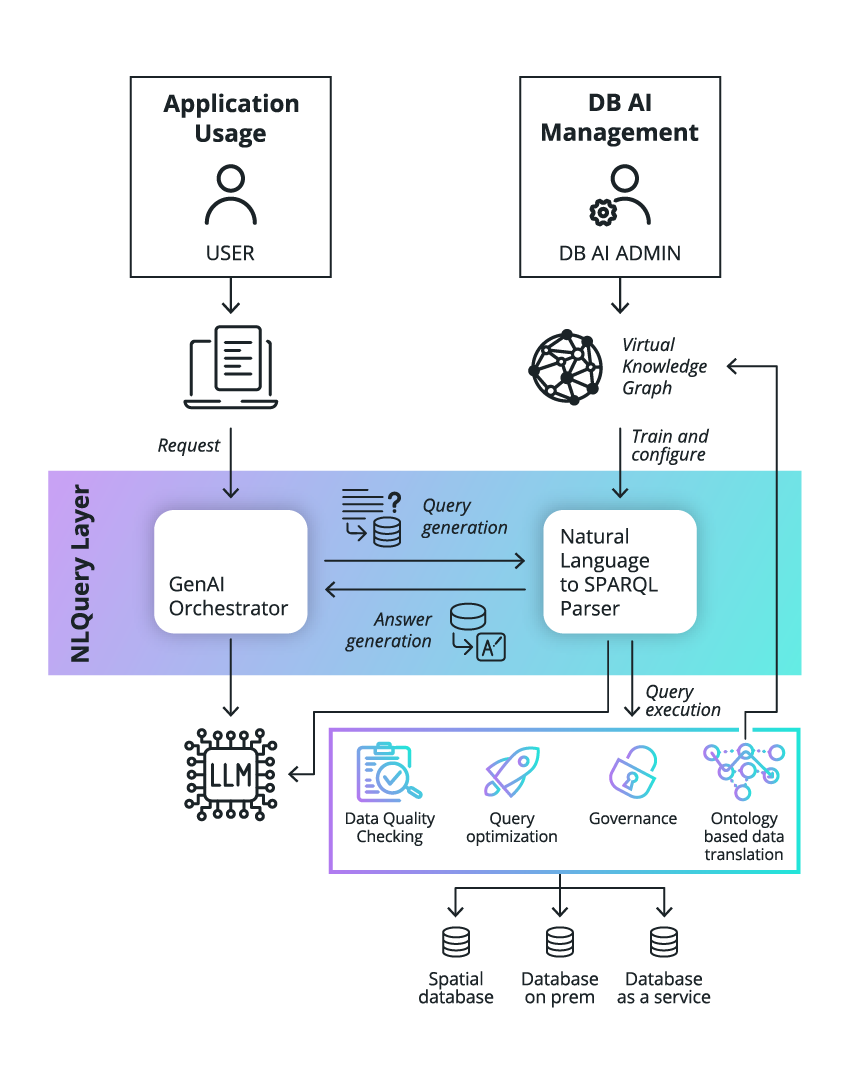
Trusted Natural Language Query Architecture

The process mirrors NLQ, but integrates a semantic layer between the database and orchestration module, leveraging ontologies and knowledge graphs to boost data quality and coherence, query interpretation accuracy, and efficiency, with added data management security.

Business Applications

Virtual Assistants integrated with NLQ

Integrating Natural Language Query into a virtual assistant enables seamless and intuitive interaction with business data. It provides natural language access to complex queries, real-time analytics, and actionable insights, all through an interactive and conversational interface. This significantly enhances user experience and productivity across various business functions. NLQ delivers instant access to real-time data, accelerating the business decision-making cycle. The ability to converse naturally with the assistant boosts user engagement and overall efficiency. When integrated into our proprietary orchestration layer, NLQ enables seamless interaction with the entire enterprise knowledge base, whether the data is structured or unstructured.

1
Data Analysis Team emprowered by TNLQ

TNLQ revolutionizes traditional data access by enabling data scientists and business analysts to have real-time, self-service access to the data sandbox without relying on a dedicated team of data engineers. This eliminates bottlenecks, improves data exploration agility, and increases overall productivity, while allowing data engineers to focus on critical tasks such as optimizing data architecture and maintaining data systems. By democratizing data access, TNLQ empowers teams to be more data-driven and responsive to business needs, ultimately facilitating faster, more informed decision-making.

With TNLQ, business analysts and data scientists can query the data sandbox using natural language, eliminating the need to write SQL or other query languages. This not only simplifies their work but also alleviates the burden on data engineers, as TNLQ handles repetitive query requests, allowing engineers to focus on higher-value tasks such as optimizing data architecture and ensuring efficient data flow.

2

Benefits

Non-tech Accessibility

NLQ empowers non-technical users to access and manipulate data using natural language, reducing dependency on IT or data teams.

Faster Decision-making

Instant access to real-time data speeds up business decision cycles.

Productivity Improvement

The ability to converse naturally with the assistant enhances user engagement and productivity.

Automation and Efficiency

Automating repetitive queries and data fetching saves time for employees, freeing them up for higher-level tasks.

Data Democratization

It opens up data insights to everyone in the organization, encouraging a data-driven culture.

Security Enhancement

With Trusted NLQ, the AI model is trained on a symbolic representation of the data and natural language is translated into a pseudo-language that is not directly executable

AIWave Approach

AIWave NLQ architecture is optimized for scalable deployment, configurable across lightweight hardware, cloud environments, or on-premises setups. Thanks to the by-design integration with AIWave proprietary AI Orchestrator, NLQ is tailored to meet diverse performance and privacy needs.
AIWave Trusted-NLQ employs a semantic representation layer to abstract the data schema while training the AI model, creating a model that remains effective through schema updates. The symbolic layer provides a protective interface, isolating cloud-based processes from direct data exposure, and facilitates deployments both in the cloud and on-premises. For additional security, a trusted semantic engine converts natural language inputs into a secure pseudo-language, ensuring that data access remains controlled and secure.

Discover more aboutGenerative AI

LLM

More than just a buzzword, LLMs are a powerful tool used for a vast array of scopes and applications.

RAG

A state-of-the-art approach to improve insights extraction and information retrieval techniques.

AI Orchestrator

An architecture that enables the seamless integration of Generative AI into business applications.